
Imagine a potential customer asking ChatGPT, "Which digital marketing agency should I hire?" Instead of browsing ten websites, they receive a shortlist with explanations and sources.
Now imagine your business isn't mentioned.
That's why AI search optimization matters in 2026. Being visible on Google is still important, but businesses also need to understand how AI-powered search tools discover, evaluate, and reference online content.
This guide explains how to optimize for ChatGPT and Perplexity using practical strategies that improve discoverability, credibility, and your chances of earning citations.
AI engines do not just rank keywords. They evaluate entity authority, corroborate factual claims across independent sources, and select clear passages that directly solve user intent.
What Is Generative Engine Optimization (GEO)?
Generative Engine Optimization (GEO) is the process of improving your content's visibility in AI-generated search answers, including responses from ChatGPT, Perplexity, and Google AI Overviews.
Traditional search engine optimization (SEO) helps your pages appear in search results. GEO focuses on helping AI search systems discover and reference your information when answering relevant questions.
For example, someone searching for "best CRM software for small businesses" might receive an AI-generated comparison that references reviews, pricing pages, and independent research.
If your website provides useful, trustworthy information, it has a better chance of becoming one of those sources.
GEO doesn't replace SEO. It builds on the same fundamentals: relevant content, technical accessibility, and credibility.
How Do ChatGPT and Perplexity Find Information?
Understanding how AI search works makes optimization easier.
When a question requires current information, AI search systems may retrieve web pages, examine relevant passages, and combine information into a response.
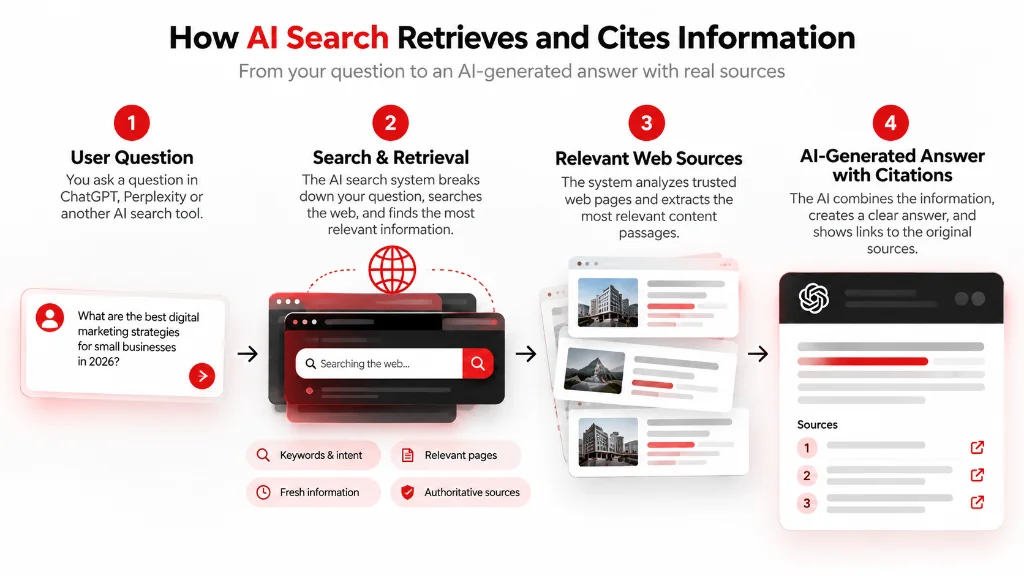
ChatGPT Search can use multiple targeted searches and reference sources. Perplexity also retrieves web information and provides supporting links. Google's AI search features use its Search index and retrieval systems.
However, these platforms don't necessarily select the same sources or display identical answers.
An important distinction: not every ChatGPT response involves a live web search. AI-generated answers may also rely on existing model knowledge.
That's why getting cited requires more than adding keywords to your website.
7 Practical Ways to Optimize for ChatGPT and Perplexity
Make Your Website Accessible to AI Search Crawlers
If relevant search crawlers cannot access your website, your content may be harder to discover.
Two important crawlers are:
Helps OpenAI discover content for ChatGPT Search.
Helps Perplexity find websites for its search results.
Review your robots.txt configuration, server responses, and CDN security settings to ensure you aren't unintentionally blocking these crawlers.
Also check that important pages are publicly accessible, internally linked, and free from unnecessary login restrictions.
Allowing a crawler improves accessibility, but it doesn't guarantee inclusion or citations.
Answer Real Questions Clearly
People often ask AI assistants complete questions rather than typing a few disconnected keywords.
Instead of writing a generic section titled "Digital Marketing," consider answering:
"What should a small business check before hiring a digital marketing agency?"
Start with a useful answer, then explain the reasoning.
Clear headings, helpful examples, and relevant explanations make content more valuable to readers and easier for retrieval systems to interpret.
You don't need to artificially divide every paragraph into tiny chunks.
Publish Original Insights Worth Referencing
AI search systems have plenty of generic information available. Your opportunity is to contribute something more valuable.
Consider publishing:
- Original research and customer surveys.
- Case studies with verifiable outcomes.
- Expert explanations of difficult topics.
- Comparisons based on real testing.
- Industry-specific insights and practical examples.
For example, a Bhubaneswar business could publish a study comparing local search visibility across different service categories.
That offers readers something they may not find in another generic SEO article.
Use genuine evidence and explain your methods. Never invent statistics to make content look authoritative.
Strengthen Your Brand's Online Credibility
Your website shouldn't be the only place where people can learn about your business.
Maintain accurate business information across relevant directories, professional profiles, and industry publications.
Contribute useful insights to reputable websites, publish expert commentary, and earn genuine mentions through noteworthy work.
These activities help build a consistent, verifiable digital presence.
Remember, purchasing fake reviews or manufacturing brand mentions isn't a sustainable GEO strategy.
Keep Your Content Accurate and Updated
AI search users frequently ask about products, pricing, technology, regulations, and recent developments.
Outdated information can weaken the usefulness of your content.
Review important pages regularly, correct obsolete claims, update examples, and provide publication or revision dates when relevant.
For rapidly changing topics, link to authoritative sources so readers can verify important details.
Accuracy matters more than simply changing the date on an article.
Use Structured Data and Strong Technical SEO
Structured data can help search engines understand supported information about your website.
Use appropriate schema types, such as Organization, Article, or LocalBusiness, wherever applicable.
Make sure your structured data accurately represents visible page content.
Also prioritize fast-loading pages, mobile usability, meaningful internal links, descriptive titles, and accessible HTML.
There is no special schema that guarantees placement in ChatGPT, Perplexity, or Google AI Overviews.
Measure Your AI Search Visibility
You cannot improve what you never measure.
Create a list of questions potential customers might ask AI assistants, then test them periodically across relevant platforms.
Record whether your brand appears, whether your website receives a citation, and which competitors are mentioned.
Check website analytics for AI search referrals, including traffic attributed to ChatGPT when available.
For example, compare results for questions such as "best SEO agency in Bhubaneswar" and "how much does local SEO cost in India?"
Because AI responses can change between searches, track patterns over time rather than treating one answer as a permanent ranking.
ChatGPT SEO vs. Perplexity SEO: What's Different?
Both platforms benefit from accessible, useful, credible content, but their search experiences differ.
| ChatGPT Search | Perplexity Search |
|---|---|
| May combine web search with conversational reasoning | Designed around search-backed answers |
| Uses OAI-SearchBot for web discovery | Uses PerplexityBot for web discovery |
| May provide citations and source links | Commonly displays linked sources alongside answers |
| Search behavior depends on the question and experience | Emphasizes retrieving information relevant to the question |
Rather than creating separate keyword-stuffed pages for each platform, build strong resources that satisfy the underlying search intent.
Common GEO Mistakes to Avoid
Some businesses approach AI search like an algorithm that can be tricked.
Avoid blocking important search crawlers accidentally, producing hundreds of repetitive AI-generated pages, publishing unsupported claims, or assuming that adding an llms.txt file guarantees visibility.
Google explicitly states that special AI text files and artificial content chunking aren't necessary for its generative search features.
Focus on improving the information itself.
Frequently Asked Questions
Final Thoughts: Optimize for People, Become Discoverable to AI
The future of search isn't simply about appearing in a list of blue links. It's also about becoming a trusted source when people ask questions.
Start with a technically accessible website. Publish original, accurate content. Build genuine authority. Then measure whether your business appears in relevant AI-generated answers.
At SEO Signature, we believe sustainable AI search visibility starts with strong SEO fundamentals and content that genuinely deserves attention.
Want to prepare your business for AI-powered search? Explore SEO Signature's SEO and AI search optimization services to build a stronger foundation for discoverability.
Ready to Get Cited in ChatGPT and Perplexity?
Let our GEO and search specialists audit your website's crawler accessibility, entity citations, and AI search readiness.
Schedule Your AI Search Consultation