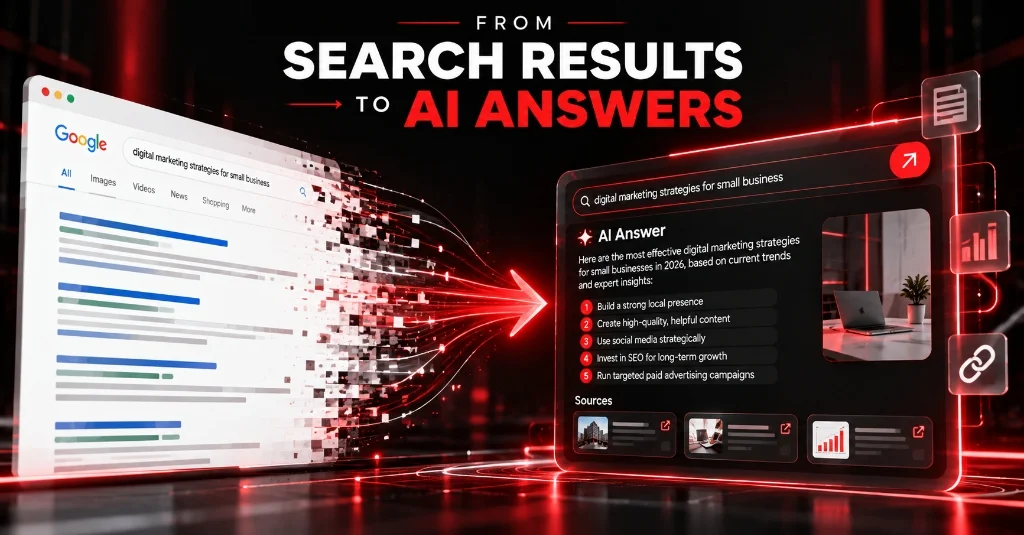
Remember when searching on Google meant opening five different websites just to find one useful answer?
You'd search for something, scan the blue links, open a few tabs, dodge advertisements, and piece together the information yourself.
Now, imagine asking, "What's the best way to market a small business with a limited budget?" and receiving a structured answer with recommendations, explanations, and supporting sources.
That's the difference AI is bringing to search.
Traditional search engine results pages (SERPs) are evolving from lists of links into experiences that can answer questions directly.
But does that mean websites will stop receiving traffic? Will SEO become irrelevant?
Not quite. The reality is more interesting, and understanding it could change how you approach digital marketing.
Search is evolving from "Search → Click → Read" into "Ask → Understand → Source Verification". Websites that provide original data and clear answers become the verified sources AI engines cite.
What Are Traditional SERPs, and What's Changing?
A traditional SERP is the page a search engine displays after you enter a query.
It typically contains organic website listings, advertisements, featured snippets, images, videos, and other search features.
For years, the basic process was simple:
Search → Find a website → Click → Get your answer.
AI-powered search introduces another possibility:
Ask a question → Receive an AI-generated explanation → Explore sources when needed.
Google AI Overviews, Google AI Mode, ChatGPT Search, and Perplexity are examples of experiences changing how people discover information.
Traditional results haven't disappeared. Instead, AI answers are becoming another important part of the search journey.
Why Are Search Engines Moving Toward AI Answers?
The biggest reason is surprisingly simple: people don't always want a list of websites. They want help solving a problem.
Here are four changes driving that shift.
1. People Want Answers, Not Just Links
Consider searching for "how to improve website conversions."
A traditional search might provide articles about landing pages, design, analytics, and copywriting.
An AI search experience can organize those topics into a practical starting plan.
That convenience makes AI particularly useful for research, comparisons, and questions requiring several pieces of information.
2. Search Queries Are Becoming Conversations
People are increasingly comfortable asking detailed questions.
Instead of searching "SEO pricing India," someone might ask:
"How much should a small business in Bhubaneswar spend on SEO, and what services should that include?"
They can then ask follow-up questions without repeating the entire situation.
Google expanded this conversational experience in 2026 by connecting AI Overviews more closely with follow-up questions and AI Mode (read the official update from Google on October 2026 improvements to AI Search links).
Search is becoming less about isolated keywords and more about understanding context.
3. AI Can Bring Multiple Sources Together
Traditional search helps people discover information across websites.
AI search can also retrieve relevant material, compare details, and summarize findings.
For example, someone researching electric vehicles might ask about running costs, charging availability, maintenance, and government incentives in one conversation.
However, AI answers aren't automatically accurate. They can misunderstand sources, omit context, or present outdated information.
For important decisions, checking the original sources remains essential.
4. Search Platforms Are Competing on Convenience
Google, ChatGPT, and Perplexity offer different approaches to answering questions.
Their shared challenge is making information easier to discover and use.
Google reported more than 2.5 billion monthly active users for AI Overviews in 2026, demonstrating how widely AI-assisted search has expanded.
For businesses, this means potential customers may encounter their brand through an AI explanation before visiting their website.
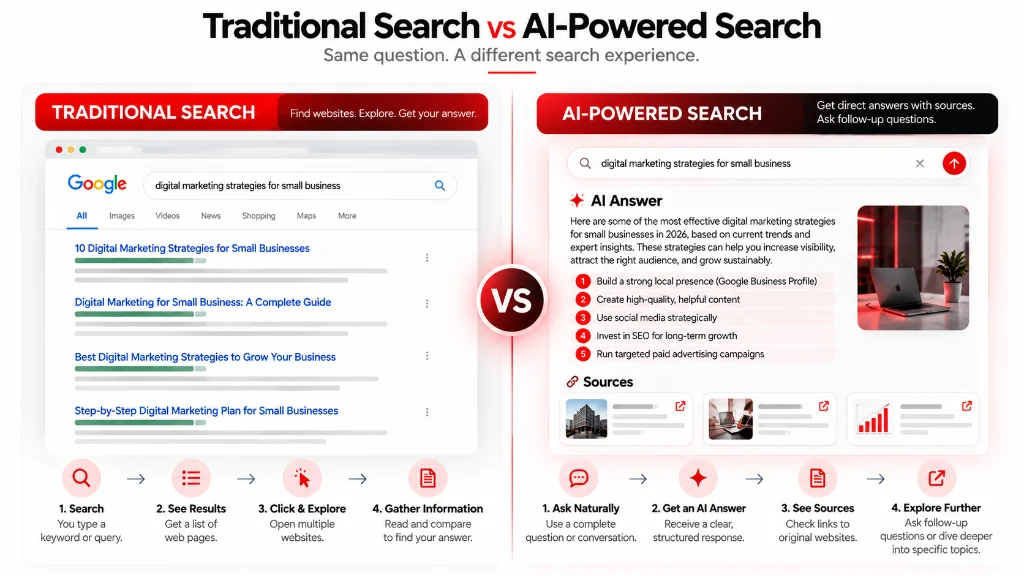
Traditional Search vs. AI Search: What's the Difference?
| Traditional Search | AI-Powered Search |
|---|---|
| Displays ranked links and SERP features | Can generate a direct explanation |
| Users often visit websites to gather details | Users may receive a summary before clicking |
| Queries are frequently keyword-based | Supports detailed conversational questions |
| Visibility is often measured through rankings and clicks | Visibility can also include mentions and citations |
| Excellent for navigation and finding original sources | Useful for explanations, synthesis, and comparisons |
Neither approach is universally better.
If you're looking for a specific company's official website, traditional search can be ideal.
If you're comparing several unfamiliar options, an AI-generated overview may provide a helpful starting point.
Are AI Answers Reducing Website Traffic?
This is where the conversation becomes important for business owners.
In a July 2025 study, Pew Research Center - AI summaries and search clicks found that users clicked traditional search results in 8% of observed visits where an AI summary appeared, compared with 15% when no AI summary appeared.
Ahrefs - February 2026 AI Overview CTR research also found that AI Overviews were associated with a 58% lower average click-through rate for top-ranking pages in its study.
These findings suggest that AI answers can reduce clicks for certain informational searches.
But they don't prove that every website will experience the same decline.
Google has reported relatively stable overall organic click volume and has continued improving links to original sources.
The takeaway? A website can remain visible in search while receiving fewer clicks from some questions. That makes it increasingly important to understand not just where your business ranks, but how people discover and evaluate it.
What Does This Shift Mean for SEO?
Here's the good news: SEO isn't disappearing.
Google's 2026 guidance confirms that foundational SEO practices remain relevant to its generative AI search experiences (see Google Search Central - Generative AI optimization guidance).
What's changing is how businesses should think about visibility.
Ranking for a keyword still matters. But being referenced as a credible source, appearing in relevant comparisons, and attracting visitors who genuinely need your services are becoming important considerations.
This is where Generative Engine Optimization (GEO) enters the picture.
GEO focuses on making useful information discoverable and reference-worthy in AI-generated answers.
Think of traditional SEO and GEO as complementary disciplines rather than competing strategies.
How Can Businesses Prepare for AI-Powered Search?
You don't need to rebuild your entire website for AI. Start with these five practical improvements.
Create Content That Answers Customer Questions
Identify questions people ask before purchasing your product or service.
For example, a digital marketing agency could explain what affects SEO pricing, how long optimization takes, or how to evaluate an agency's work.
Provide useful answers before introducing your services.
Offer Information AI Cannot Easily Find Elsewhere
Original case studies, first-hand testing, expert observations, and transparent comparisons give readers a reason to trust your website.
A generic article can be summarized easily. Unique research offers something worth referencing.
Make Your Website Technically Accessible
Maintain crawlable pages, descriptive headings, clear internal links, mobile usability, and appropriate structured data.
Google's AI search features still rely on core search indexing and quality systems.
There is no guaranteed AI visibility shortcut.
Build a Consistent, Credible Brand Presence
Keep business details accurate across your website and reputable third-party platforms.
Publish evidence of your experience, showcase genuine work, and earn relevant industry mentions.
Credibility should be demonstrated, not manufactured.
Measure More Than Rankings
Continue monitoring organic traffic, conversions, and keyword performance.
Also examine referral traffic from AI platforms where identifiable, relevant brand mentions, and citations in AI-generated answers.
A useful question is no longer only, "Where do we rank?"
It's also, "Are customers discovering and trusting us?"
Authoritative Research Citations & Data Sources
Frequently Asked Questions
Final Thoughts: The Future of Search Is About Being Useful
Search is moving beyond simply helping people find information. Increasingly, it helps them understand information.
For businesses, that creates both a challenge and an opportunity.
Some informational searches may generate fewer website visits. At the same time, brands that contribute genuinely valuable insights have new ways to be discovered.
The smartest response isn't abandoning traditional SEO or chasing every new AI trend.
It's building a website that deserves attention, answers meaningful questions, and gives people a compelling reason to choose your business.
At SEO Signature, we help businesses strengthen their search foundations while preparing for changing discovery experiences.
Want your brand to stay discoverable as search evolves? Explore SEO Signature's SEO and AI search optimization services and build a strategy designed for people, not just algorithms.
Prepare Your Business for AI Search Overviews
Partner with SEO Signature to optimize your search architecture, protect organic reach, and secure authoritative AI citations in 2026.
Schedule Your Search Consultation